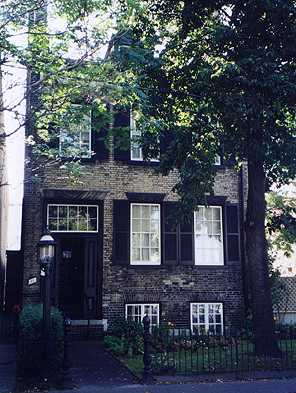
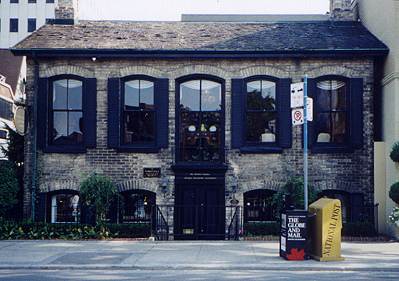
This page continues the guide to historic buildings of Toronto with 6 further entries, among them Mackenzie House, John Daniels’ House and Yorkville Fire Hall and Coat of Arms. Each entry has a short description and a photograph, and many reproduce the wording of a heritage plaque. The listing was compiled earlier and keeps its original text. Other pages in the series: Part 1 Part 2 Part 4 Part 5 Part 6 Part 7 Part 8.
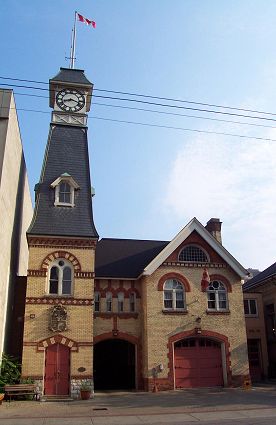
Yorkville Fire Hall and Coat of Arms (left)
6 Trinity Square, located behind the Eaton Centre and adjacent to Holy Trinity Church, was the home of the Reverend Henry Scadding between 1862 and 1901. The historic plaque on the building reads: “Scadding was born in Devonshire, England in 1813, and came to Upper Canada in 1821. Educated at Upper Canada College and Cambridge University, he was ordained to the Anglican priesthood at St. James Church, Toronto, in 1838, and the same year became Master of Classics at Upper Canada College. In 1847 Scadding was appointed first rector of the nearby Church of the Holy Trinity, where he served until 1875. He lived in this town house, which complements the church and was designed by William Hay, from its completion in 1862 until his death. Here scadding, a noted scholar, wrote numerous religious, literary, and historical works, including his best-known books, “Toronto of Old” (1873) and, in collaboration with J.C. Dent, “Toronto: Past and Present” (1884).”
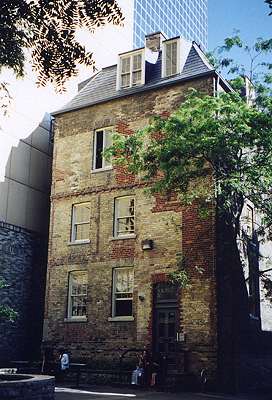
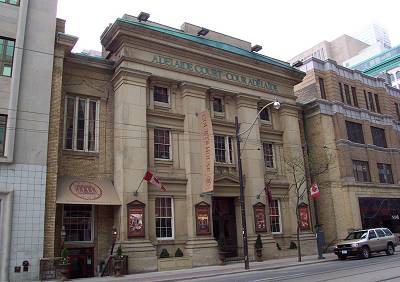
The York County Court House, located at 57 Adelaide Street East, was designed by Cumberland and Ridout and built in 1851-52. Cumberland and Ridout were also the architects responsible for the current incarnation of St. James’ Cathedral, built in 1853. After the building ceased to function as a courthouse, it served as a meeting place for the Arts and Letters Club of Toronto in the early 1900’s. Today it is home to The Court House Market Grill and Restaurant.
The “Royal Alex” is located on King Street West. The historic plaque reads: “Constructed in 1906-07, this theatre is an intimate but lavish version of the traditional 19th century theatre, with two balconies as well as side boxes. John M. Lyle (1872-1945), one of Canada’s most distinguished architects of the 20th century, designed the Royal Alexandra Theatre following the Beaux-Arts style thus providing an elegant setting for Toronto’s sophisticated theatrical and musical events. Since its rescue and restoration by Ed Mirvish in 1963, when it was to be demolished for a parking lot, this theatre again plays a central role in the social and cultural life of the city.”