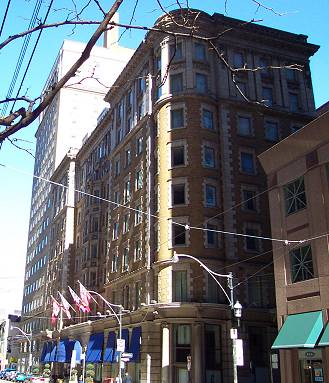
This page continues the guide to historic buildings of Toronto with 6 further entries, among them Consumers’ Gas Building, The King Edward Hotel and Toronto Street Post Office. Each entry has a short description and a photograph, and many reproduce the wording of a heritage plaque. The listing was compiled earlier and keeps its original text. Other pages in the series: Part 1 Part 2 Part 3 Part 4 Part 6 Part 7 Part 8.
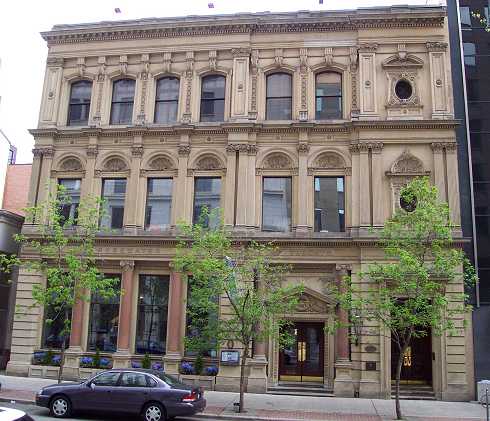
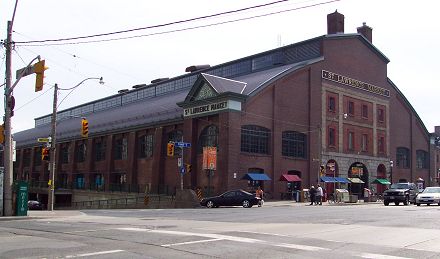
The south St. Lawrence Market building at King and Jarvis Streets began life as Toronto’s second City Hall. Designed in 1844 by architect Henry Bowyer Lane, the building housed the council chamber and municipal offices on the second floor, Police
Station #1 on the main floor, jail cells in the basement, and a market area in the rear. Over the latter half of the 19th century as the city grew, various alterations were made to the building, but by the late 1800’s it was clear that the space was no longer adequate. The civic offices were transferred to the “new” City Hall at Bay and Queen in 1899, and the vacated building was radically altered to provide a larger market for the city. The central portion of the original building survives today as part of the south St. Lawrence Market, seen here. The second floor houses the Market Gallery of the City of Toronto Archives, which occupies the original council chamber.
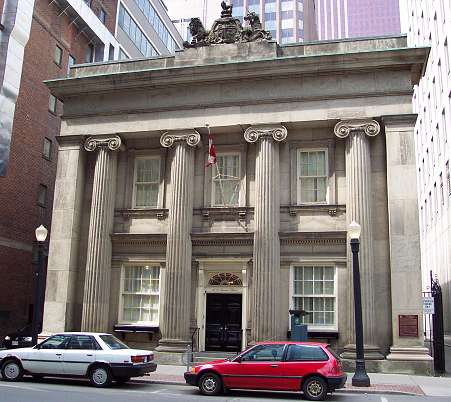
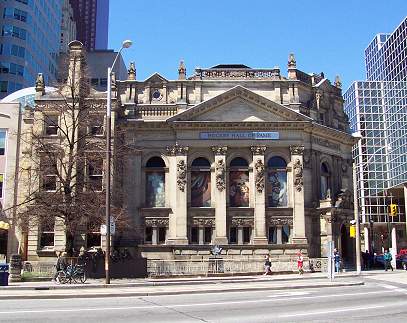
Located at Yonge and Front Streets, The Hockey Hall of Fame occupies the 1885 Bank of Montreal building. Darling and Curry, the architects, also designed the Victoria Hospital for Sick Children on College Street. The 1885 building replaced a smaller one of 1845, and was the head office of the bank in Toronto. After the second world war a new head branch was opened at King and Bay. The Yonge and Front branch continued in business until 1982, when it closed. In the late 1980’s as part of the BCE place development, the building was restored and renovated, and opened as the Hockey Hall of Fame in 1993.
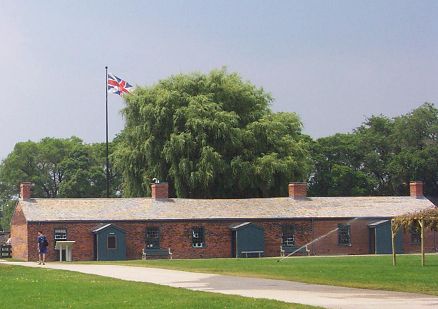
When Lieutenant Governor John Graves Simcoe arrived at the future site of Toronto in 1793, one of his first priorities was to construct a military garrison. With the help of the Queen’s Rangers, the Loyalist Regiment he commanded in the Revolutionary War, he did so on a site two miles west of the original Town of York. Simcoe left York before long, but his instincts about the American threat were accurate, and American troops invaded and occupied York twice during the War of 1812, destroying most of the original fort in the process. After the war the fort was rebuilt, but fell into disrepair towards the end of the 19th century, particularly after a new garrison was built west of the original fort in 1841. In 1909 the city bought the fort and restored it between 1932-34 as part of Toronto’s centennial celebrations. The present buildings at Fort York are a combination of restored original structures from the 1813-15 period and replica buildings.