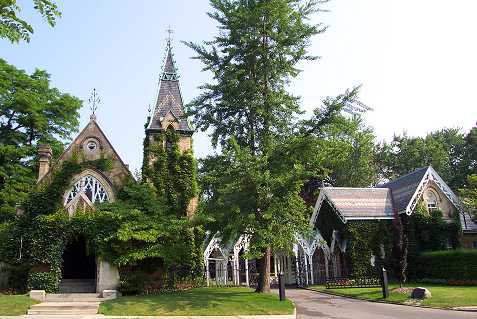
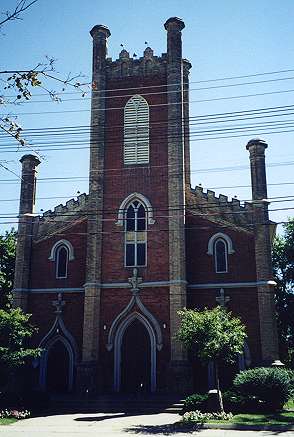
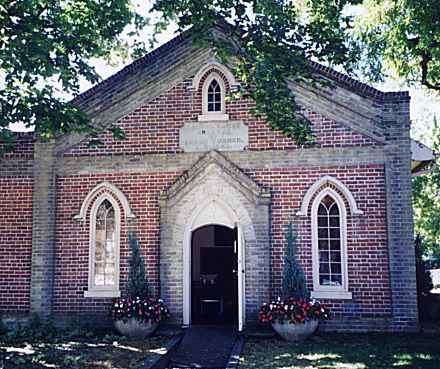
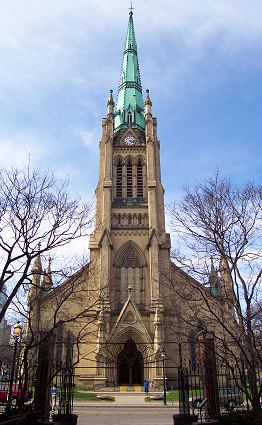
This page continues the guide to historic churches of Toronto with 5 further entries, among them Little Trinity Church, Enoch Turner Schoolhouse and St. James’ Cathedral. Each entry has a short description and a photograph, and many reproduce the wording of a heritage plaque. The listing was compiled earlier and keeps its original text. Other pages in the series: Part 1 Part 3 Part 4 Part 5 Part 6.
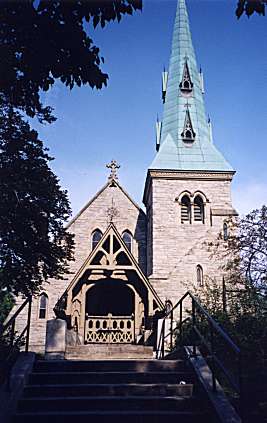
St. James-the-less Chapel is located inside the main gates of St. James’ Cemetery, on Parliament Street near Danforth Avenue. In the early years of Toronto’s existence, burials took place on the grounds of St. James’ Cathedral (King and Church), and although the cemetery at that location has long been disused and no markers are visible, the remains of some of York’s earliest residents lie beneath the parking lot. (some of the markers can be seen inside the vestibule of St. James’ Cathedral) The historical plaque outside St. James-the-less Chapel reads: “In its vigorous, harmonious composition, this small funeral chapel is a splendid example of High Victorian Gothic design. Its sense of strength and spirituality is derived from the subtle contrast of its stone walls, enveloping roofs, and soaring spire. The chapel was erected in 1860 to plans by Cumberland and Storm, one of Toronto’s leading 19th-century architectural firms. Situated on a slight rise, St. James is enhanced by the picturesque setting of its cemetery, which was opened in 1844 and is the oldest established cemetery in the city.”
Located at Winchester and Sumach Streets, the Necropolis (literally “city of the dead”) began operating in 1850. It replaced Toronto’s first non-sectarian burial ground, Potter’s Field, which closed in 1855 due to the rapid growth of the city and the cemetery’s location at Yonge and Bloor. The historical plaque on the Necropolis Chapel reads: “The Chapel at the Toronto Necropolis, together with adjoining entry pavillion and superintendent’s office and residence constitute one of the finest examples of Gothic Revivial architecture in Canada. The unique composition of buildings was designed by architect Henry Langley in 1872. The Chapel, whose arch is the most prominent decorative feature, has a distinctly Gothic motif, including the large arched front stained glass window lighting the nave and the arched rose window of stained glass lighting the sanctuary and chancel. An unique aspect of the chapel’s architecture is the placement of the bell tower at the rear, over the sacristy, a sensible design for funeral processions entering through the porch and passing through the large nave to the chancel and finally through the sacristy to the cemetery grounds. Henry Langley, a Toronto architect, was noted for his use of Gothic Revival style in churches. He died in 1906 at the age of seventy, and was buried in the Toronto Necropolis (section O, Lot 255).”